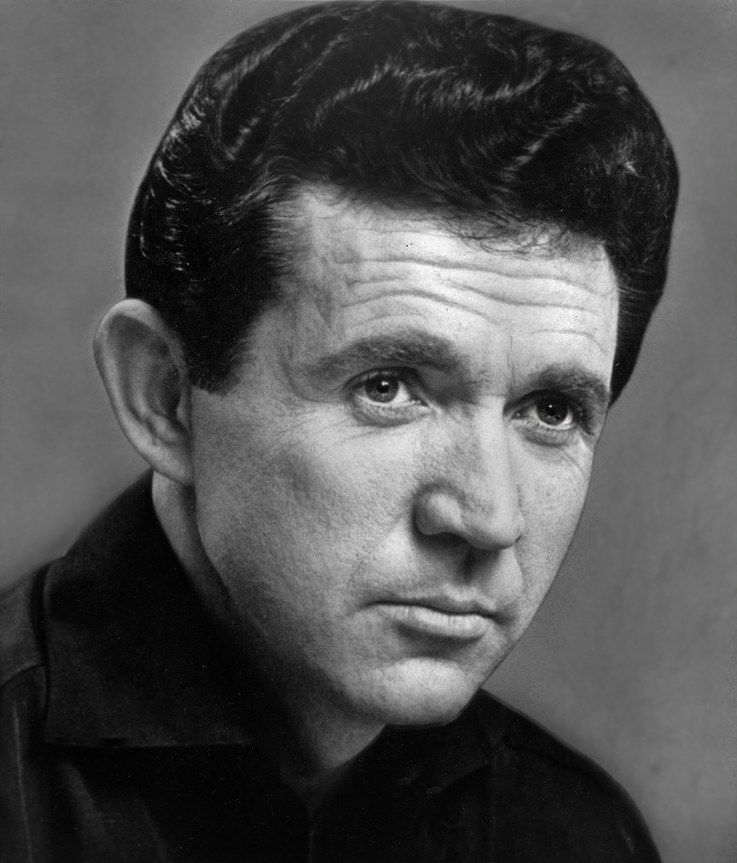
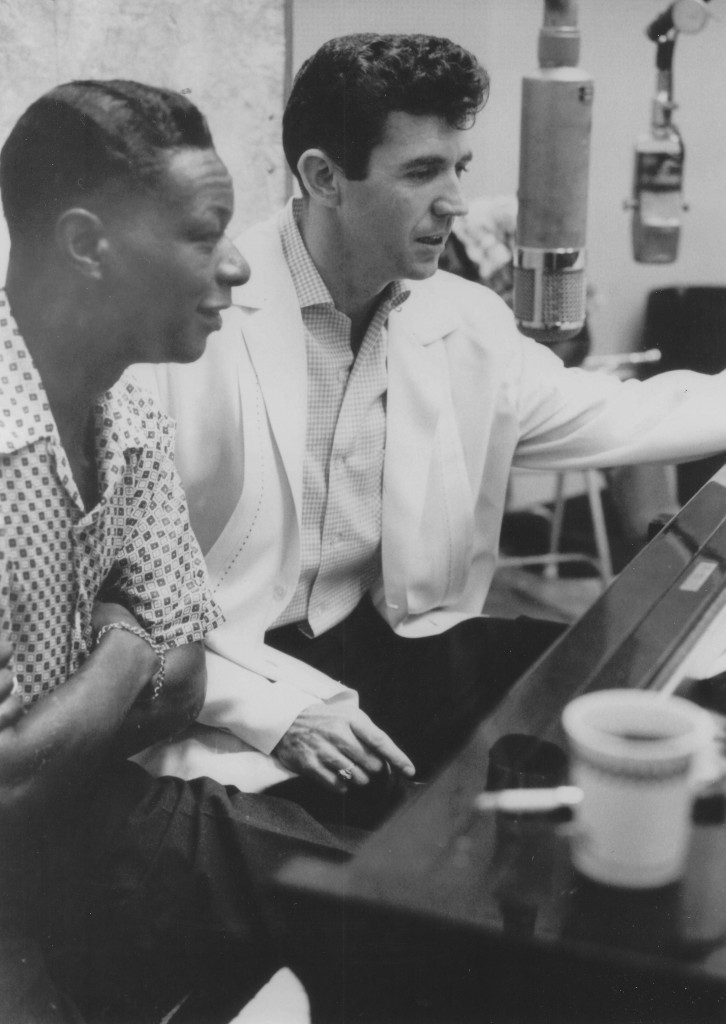
SONNY JAMES
The Southern Gentleman
From 1953 to 1983, The
Southern Gentleman has had a total of 72 Chart Hits.
By the mid 1960’s the career of Sonny James would reach new
heights. Starting with his hit recordings "The
Minute You’re Gone"
and "Baltimore", "You’re
The Only World I Know"
climbed to Number One country in 1964 spending four weeks in
that position.
JOHN BUSH
(All Music Guide)
“That began one of the greatest tears country music has ever
known: 21 of Sonny James’ next 25 singles hit Number One (and
the other four were near-misses with three reaching No. 2 and
the other
No. 3)” --- During this streak of hits, James scored an incredible five year run of
16 Consecutive
Number One Singles… a feat never before accomplished in
country music, pop or rock ‘n roll. If we use the same
criteria used today for determining #1 singles, James would
have had an unbelievable 25 number ones in a row.
(Billboard, Cashbox,
Gavin, Radio & Records)
According to Billboard statistics, for nineteen
years (1960-1979) he spent more time in the Number One chart
position than any other artist in country music --- a total
of 57 weeks.
(Record Research, Inc. Joel Whitburn’s Top
Country Singles 1944-2001)
On August 30th of this year,
the day it was announced that Sonny James was to be an
inductee into the Country Music Hall of Fame, Kix Brooks
(Brooks And Dunn) probably said it best, "This
is an artist who really dominated his time in history."
The foundation for this success was laid years before
when in late 1956 this Alabama native took his guitar, a
simple musical arrangement and sang what would become his
signature song
"Young
Love".
Capitol Records discovered radio stations of all formats were
programming “Young Love” and was taking country music to scores of fans
it had never reached before. The record soared to top all charts
(classical being the exception) to become one of the most recognizable
hits ever. It was the first traditional country teen crossover hit.
(Followed by fellow Capitol artist Ferlin Husky’s “Gone”... and a few
months later Marty Robbins’ “White Sport Coat”). Over forty years later
“Young Love” is still programmed around the world.
TELEVISION
The importance of television no doubt played a key role in James’
recording career. His years as a cast member with The Ozark Jubilee
(ABC-TV) and his frequent appearances on the nationally televised Ed
Sullivan Show introduced his new releases to millions of viewers, while
creating additional interest for guest appearances on other television
programs, notably Bob Hope, Andy Williams. Variety Specials also gave
valuable exposure.
In 1961 he became the first country artist (recording division) to be
honored with a star in the prestigious Hollywood Walk of Fame (Located
across from Grauman’s Chinese Theatre 6628-6636). He joined the world
famous Grand Ole Opry in 1962 where he regularly appeared until touring
schedules would not permit him time to both tour and return to Nashville
for the required Opry programs.
In 1967 the honors continued when James would host the first CMA Award
Show - Country Music Association’s recognition of country’s top writers
and performers. With Bobbie Gentry as his co-host, the two no doubt
played a major role in what has become an annual event, and one of
television’s highest rated programs.
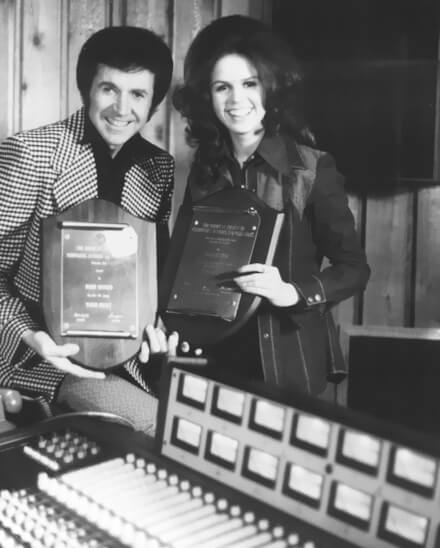
In the 60s and 70s he received numerous awards from Billboard magazine
and other publications for his hit recordings and personal appearances.
Was named Male Artist of The Decade by Record World.
On January 31, 1971 Sonny James took a trip to the moon! By special
request James was honored to be the first country artist to record a
program exclusively for a moon flight. In appreciation, the crew of
Apollo 14, Stuart Roosa, Edqar Mitchell, Commander Alan Shepard,
presented him with a flag they carried to the moon ... one of James’
prized possessions.
In 1987 James was inducted into the Alabama Music Hall of Fame- the
Lifework Award for Performing Achievement.
Honors received 2001-2002.
June, 2001
MALE GOLDEN VOICE AWARD
-Golden Voice Awards
November, 2001
MASTER ACHIEVEMENT AWARD
R.O.P.E. AWARDS
June, 2002
CAREER ACHIEVEMENT AWARD
-The Country Music DJ Hall of Fame
and Country Radio Broadcasters, Inc.

|
The
following reference material follows many requests by fans to see an
historical view of Sonny's career during his most popular years. This
reference does not include "Young Love" & other popular releases between
1956 & 1959.
(Record Research, Inc. Joel Whitburn's Top Country Singles 1944-2001)
A special thanks to Allan M. Miller,
Our Three Sons Broadcasting,
for his research & efforts regarding the following statistics.
|
|
BILLBOARD STATISTICS
Top 15 Country
Hitmakers 1960-1979 |
|
ARTISTS & #1 HITS |
ARTISTS & WEEKS AT #1 |
| Conway
Twitty: |
28 |
Sonny James: |
57 |
| Merle
Haggard: |
24 |
Buck Owens: |
44 |
|
Sonny James: |
22 |
Merle
Haggard: |
43 |
| Charley
Pride: |
22 |
Charley
Pride: |
41 |
| Buck Owens: |
20 |
Conway
Twitty: |
37 |
| Tammy
Wynette: |
20 |
Tammy
Wynette: |
37 |
| Loretta
Lynn: |
16 |
Johnny
Cash: |
33 |
| Marty
Robbins: |
10 |
Marty
Robbins: |
30 |
| Waylon
Jennings: |
10 |
Waylon
Jennings: |
26 |
| Dolly
Parton: |
10 |
Bill
Anderson: |
23 |
| Johnny
Cash: |
8 |
George
Jones: |
22 |
| George
Jones: |
8 |
Loretta
Lynn: |
21 |
| Bill
Anderson: |
7 |
Eddy
Arnold: |
20 |
| Eddy
Arnold: |
7 |
Jim Reeves: |
19 |
| Jim Reeves: |
6 |
Dolly
Parton: |
13 |
| |
|
ARTIST & BILLBOARD RANKING |
ARTIST & TOP 10 HITS |
| George
Jones: |
7237 |
Loretta
Lynn: |
47 |
| Buck Owens: |
6019 |
George
Jones: |
46 |
| Johnny
Cash: |
5833 |
Buck Owens: |
45 |
| Merle
Haggard: |
5353 |
Merle
Haggard: |
44 |
|
Sonny James: |
5207 |
Conway
Twitty: |
43 |
| Loretta
Lynn: |
5204 |
Charley
Pride: |
38 |
| Conway
Twitty: |
4989 |
Sonny James: |
37 |
| Bill
Anderson: |
4866 |
Tammy
Wynette: |
35 |
| Tammy
Wynette: |
4253 |
Bill
Anderson: |
35 |
| Charley
Pride: |
4107 |
Marty
Robbins: |
32 |
| Waylon
Jennings: |
4102 |
Johnny
Cash: |
31 |
| Dolly
Parton: |
4100 |
Waylon
Jennings: |
30 |
| Eddy
Arnold: |
4033 |
Dolly
Parton: |
30 |
| Marty
Robbins: |
4031 |
Jim Reeves: |
29 |
| Jim Reeves: |
3984 |
Ray Price: |
25 |

|
SONNY JAMES
MOST POPULAR RECORDINGS |
|
• YOUNG LOVE
•
I’LL NEVER FIND ANOTHER YOU
•
IT’S THE LITTLE THINGS
•
NEED YOU
•
YOU’RE THE ONLY WORLD I KNOW
•
BORN TO BE WITH YOU
•
BRIGHT LIGHTS, BIG CITY
•
HEAVEN SAYS HELLO
•
DON'T KEEP ME HANGIN’ ON
•
TAKE GOOD CARE OF HER
•
RUNNING BEAR
•
MY LOVE
•
HERE COMES HONEY AGAIN
•
FOR RENT
•
SINCE I MET YOU BABY
•
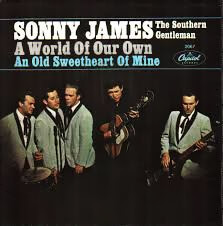
A WORLD OF OUR OWN
•
BEHIND THE TEAR
•
THAT’S WHY I LOVE YOU LIKE I DO
•
WHEN THE SNOW IS ON THE ROSES
•
IT’S JUST A MATTER OF TIME
•
ENDLESSLY
•
A LITTLE BIT SOUTH OF SASKATOON
•
ROOM IN YOUR HEART
•
THE CAT CAME BACK
•
EMPTY ARMS
•
ONLY THE LONELY
•
TRUE LOVE’S A BLESSING
•
BALTIMORE
•
IS IT WRONG
•
I’LL KEEP HOLDING ON (JUST TO
...YOUR LOVE) |
• ONLY LOVE CAN BREAK
A HEART
•
WHITE SILVER SAND
•
COME ON IN
•
AMI-ESPOSA CON AMOUR
...(TO MY WIFE WITH LOVE)
•
THE MINUTE YOU’RE GONE
•
LITTLE BAND OF GOLD
•
WHAT IN THE WORLDS COME
...OVER YOU
•
GOING THROUGH THE MOTIONS
...(OF LIVING)
•
TWENTY FEET OF MUDDY WATER
•
CARIBBEAN
•
I LOVE YOU MORE AND MORE
...EVERYDAY
•
FIRST DATE, FIRST KISS, FIRST LOVE
•
JENNY LOU
•
UH-HUH-MN
•
ASK MARIE
•
WHEN SOMETHING IS WRONG
...WITH MY BABY
•
THE PRISONER’S SONG
•
THAT’S ME WITHOUT YOU
•
SHE DONE GIVE HER HEART TO ME
•
YOU’RE FREE TO GO
•
IN THE JAILHOUSE NOW
•
THIS IS THE LOVE
•
LOVE SICK BLUES
•
YOU’RE THE REASON I’M IN LOVE
•
INNOCENT LIES
•
TIL THE LAST LEAF SHALL FALL |

DAVE SAMUELSON
(Music historian and Biographer)
Recently Samuelson did a one on one interview with Sonny James on
special assignment - an insight on the early years. Here are some
excerpts from that interview.
Sonny James (Loden) was born May 1, 1929 in Hackleburg, Alabama, a small
agricultural center about ninety-five miles northwest of Birmingham. His
parents, Archie and Della Burleson Loden, operated a 300-acre farm about
six miles outside of town. Their farm supported three tenant families, who
cooperatively used teams of horses and mules to raise enough cotton,
corn and hay to see them through each season.
Along with his sister Thelma, who was born five years earlier, “Sonny”
James grew up listening to music. Both of his parents were musicians.
“Pop” Loden played guitar and fiddle but preferred the five-string
banjo, while “Mom” played guitar in an open tuning. Thelma -whom the
family always called “Sis”- learned guitar as soon as she could wrap her
left hand around the fingerboard. The family owned a wind-up Victrola-
Pop particularly liked Jimmie Rodgers’ records- and a battery- powered
radio introduced them to pop singers like Kate Smith.
James vividly retains childhood memories of Saturday nights when local
musicians gathered in each others’ homes to play music amid the bronze
glow of Aladdin and coal-oil lamps. “I used to play around on a broom”,
he said. “That’s when Pop decided, ‘Well, I’ll give him something that
he can at least play around on.’ That’s when he cut the molasses bucket
in half and used the bottom of it and put a neck on it and then reversed
it. It became the top of a little banjo, but it was tuned like a
mandolin- So then I graduated to a mandolin and long about that time -I
must have been about three or something - I began singing.”
By age eight, Sis Loden was a confident singer and skilled rhythm
guitarist with a knack for picking up contemporary hill-billy or pop
tunes. Mom’s voice soared over the others, creating a harmony that
paralleled with what Rose Carter later did with the Chuck Wagon Gang.
When Pop added the necessary bass vocals, the Loden Family’s sound began
to gel.
In 1933, Pop Loden arranged an audition with WMSD in Muscle Shoals,
Alabama, impressed with the family’s performance, the station manager
offered them a regular Saturday slot. James also remembers when the
family won a Mid-South Champion Band contest. “The prize or the reward
for winning was-I think they might have had some money, I don’t
recall--you’d get to play two weeks on WAPI” he said. ‘it was a
5,000-watt station, one of the leading stations in Birmingham at that
time. They would get a big artist to come in to headline the band
contest, and Kate Smith happened to be that artist. She saw us do our
show-now this is what Pop and all of them had said- she kind of took a
liking to us. She must’ve for some reason took a liking to me. She had
me on her lap, gave me a silver dollar and said that some day I would
have a bright future in the entertainment field.”
Later that year Pop and Mom Loden volunteered to raise an Arkansas
youngster who was about Sonny’s age. Ruby Palmer loved the family’s
music and was soon incorporated into the group. She began playing bass
and handling yodels on Western-flavored numbers, and duets with Thelma.
Her excellent voice was a key in the group’s trio and quartet.
By 1936 the Loden family was a popular attraction throughout the South.
“We sang everything from Jimmie Rodgers to whatever was on the radio,”
James recalled. “When we hit the stage, always from the first time I was
little, when the curtain went up we were playing, and we started off
with something fast, do another full number before Pop would ever say
anything. He got the show started in a good way!
Pop made sure that no two Loden Family shows were ever alike. “He used
a mixture of not only the tempo of the song-slow, medium, fast- but a
variety, like Sis and Ruby should sing a duet and then I would sing
something and I’d play an instrumental. You didn’t have the sameness
following the other numbers. We tried to make it entertaining. I think
one way of doing that is you mix your tempos up and you mix your sound
up when you do a trio, a folk-type song, or when you’d be doing
something from the hills like Molly O’Day or Roy Acuff.”
Though a musical
career is admittedly risky, the family’s success convinced Pop Loden to
turn professional. “As our personal appearances would do a little bit
better, then we’d come back home, and then we’d go again and come back
home,” James recalled. “Finally he decided, ‘Well, we’re going to try
it in Blytheville, Arkansas at KLCN.”
Fortunately, the Lodens were in a position to take such a risk. “We’d
have the farm as a backup--what we got from the renters and what we got
off of our farm,” he said. “Of course, they’d cover for Pop any of the farming that needed to be done for him while he
was away.”
Pop Loden also made sure his decision did not affect his children’s
education. “I went to several schools but it was never hard on me,”
James admitted. “Pop wouldn’t ever book anything so far that I couldn’t
go to school and live a normal life. Consequently I participated in all
sports and he
was most cooperative. I never was held out of anything.”
Despite a paltry 1000-watt signal, KLCN blanketed Arkansas, southeastern
Missouri and western Tennessee as effectively as any 10,000-watt
station. “We had good reception and the station was able to get good
sponsors for us’, he said. “I’ve advertised everything from Griffin Shoe
Polish to you name it. I used to sing the theme song. The way we’d start
out would be the first thing you’d hear right out of the news. You’d
hear this train whistle. Sis and band playing real fast, and I’d blow it
two or three times. I’d sing ‘Don’t forget your suitcases, umbrellas and
ba-a-a-a-bies!’ “That was every morning. That was the way we opened up
when people got up in the morning. I’d see people in school and they got
the biggest kick out of that. They’d all sing, “Don’t forget your
suitcases. . .”
With the tenant farmers taking care of the Loden property back in
Hackleburg, the family concentrated on its music and personal
appearances. “You’d work a radius of maybe two hundred miles around,”
James said. “The radio station would cover it and that was your means of
advertising. Basically we would play school auditoriums. A lot of towns
had one theatre of course. Occasionally we’d play an outside- what we’d
call a picnic, a musical picnic- but basically it was schoolhouses and
theatres.”
On some of those dates the Lodens shared billings with another radio
group working out of northeastern Arkansas, The Wilburn Family,
including young Teddy and Doyle Wilburn.
The Loden Family left Blytheville two years later for brief stints over
stations in Greenwood and Columbus, Mississippi, before securing an
extended slot over WJDX in Jackson. By then the group had matured into a
self-contained show band, often in demand as an opening act for
traveling radio and recording headliners. Musically, the family could
handle virtually any type of song, from pop tunes like “Now Is The Hour”
to Bob Nolan’s classic Western specialties. James credits his sister
Thelma as one of the key factors in the family’s success. “My sis was
one of the funniest comediennes you ever saw,” he said. “She
participated in whatever we were doing. From the time she came on until
it was all over, it was all upbeat. She knew when to talk and when not
to ... her timing and actions were just plain funny. She’s the nearest
thing to a female Red Skelton or Homer and Jethro that I ever saw..not
just a rube comic..she did that, but was also cleverer. And the more I’d
laugh, the more she’d laugh. The audience ate it up.”
Just before the end of World War II, Lowell Blanchard brought the Loden
Family to Knoxville to appear on his daily Midday Merry-Go-Round and
Saturday night Tennessee Barn Dance over WNOX. “I don’t even remember
auditioning for Lowell” James admitted, “so evidently Lowell heard us
somewhere.”
Blanchard’s impressive talent roster at the time included Cliff and Bill
Carlisle, Archie Campbell, Eddie Hill, Johnny Wright, Molly O’Day and
Lynn Davis, and occasionally Chet Atkins. Lost John Miller briefly
worked on WNOX during the winter of 1945-46. James remembers hearing and
becoming friends with Miller’s banjo player, Earl Scruggs.
During the family’s stay at WNOX, Pop hired accordion player Buddy
Baines as a concession to the current style in country music. When they
moved to WPTF in Raleigh, North Carolina early in 1946, Lois Brock
replaced Baines.
While in Raleigh, James roomed with two musicians working in Johnny and
Jack’s Tennessee Mountain Boys, Chet Atkins and fiddler Paul Warren.
“We’d just pick up a storm” he recalled.
“A lot of people didn’t know it, but a little of that comes out in songs
like “I’ll Never Find Another You” and “A World of Our Own’. If you
listen to the guitar work there, you know I like that kind of picking.
We jammed a lot.”
In retrospect, James considers the stays in Knoxville and Raleigh as the
family’s professional and artistic peak. In 1949 the group returned to
Alabama, landing a slot over WSGN in Birmingham.
From there the family joined WMPS, Memphis, where they reconnected with
Eddie Hill,then a daily show with Ira and Charlie Louvin. “We’d do an
hour show,’ James said. We’d do the first thirty minutes then Eddie
would do thirty. Eddie and the Louvin Brothers would do a
fifteen-minute program. Then Eddie would come on and say, ‘Welcome and
for all the sick and shut-ins’..That was the approach and it was easy.
He’d emcee and Charlie and Ira would sing.”
Around Christmas 1949, Thelma Loden and Ruby Palmer were married in
double ceremonies in West Memphis,Arkansas and both left the act. Pop
Loden hired two or three musicians to maintain the WMPS job, but things
weren’t the same. “It was a good band but after the girls got married,
we just weren’t into it,” James admitted. Using money they saved, Pop
and Mom Loden returned to Hackleburg and opened a clothing store. “I
think they were at that time ready to come home, James said. “They were
happy and I felt they worked a little bit hard- I don’t mean in toil,
but in long hours.”
During that period James joined the National Guard and completed his
final year at Hackleburg High School.
Despite its popularity, the Loden Family left virtually little behind
for posterity. They thrived in an era when the record business primarily
served juke box owner-operators. Since family acts like the Lodens, the
Wilburns and the Everlys did not play honky-tonks, major labels didn’t
seek them out. The few that made records, such as the Chuck Wagon Gang
and the Johnson Family Singers, generally limited their repertoires to
sacred numbers. As a consequences once-vital segment of country music’s
heritage has been lost to history.
GOING SOLO
Now out of school and back in Hackleburg, James worked in the family
store and pondered his future options. Torn between continuing his
education or pursuing a career in music, he opted to return to radio
until he made a decision. He contacted a friend of his in Memphis,
Freddy Burns, who fronted a band featured on a noontime show on WHBQ
that fed to stations on the Mutual Broadcasting System. “I said, ‘Until
I decide what I’m gonna do, would you be interested?’ He was already
familiar with the family, knew all the family and all of that from my
background. He said, ‘Shoot yes, son! Come right on!’ So he more or less
took me under his wing so I started doing this daily network show with
him.”
During summer 1950, James essentially served as the band’s utility man,
playing fiddle and handling the occasional vocals. From that beginning,
he was soon offered his own fifteen-minute show each day, performing by
himself with a bassist for support, for the Mutual Network. “I was out
there doing that when Pop called me,” he said ‘Son, Capt. Brumley just
called and said you all are on active duty.”
I said ‘What?’
“He said, ’Yeah, this conflict they’re having, they’ve placed you all on
active duty. They need troops.”
Returning to Alabama, James joined his fellow Guardsmen with the 252nd
Truck Company from Hamilton, Alabama. “On Sept. 9, 1950 they shipped us
to Seattle-Fort Lawton” he said. “It was port of embarkation, which
should tell you they didn’t intend for us to stay there long. We just
stayed there a short time and then they shipped us to Korea. Our company
and a unit from Pennsylvania I believe, were the first National Guard
Troops in Korea.”
James’s company was to land in Inchon, about one hundred miles south of
the 38th Parellel. China’s entry into the conflict forced the 252nd
Truck Company to disembark at Pusan on the Korean peninsula’s southern
tip. “We were attached to the 2nd U.S. Infantry Division..
our primary mission was to re-supply the front line with food,
ammunition, gas, personnel, equipment, carry prisoners of war
casualties--just anything.” Altogether the Unit carried more tonnage
than any other truck company assigned to the Eighth Army. The 252nd
remained in Korea for a time after a cease-fire ended the hostilities.
During their service in Korea, the group lost only one member.. none of
the Hamilton-based Guardsmen were casualties. Their company was awarded
the Presidential Unit Citation and one of just two units in the nation
to receive a citation for their service in the Korean conflict.. also
the Meritorious Unit Commendation.
James continued to hone his musical skills. Though he left his good
instruments in Hackleburg, he kept a fiddle and an old Epiphone guitar
wherever he was stationed. Though he had dabbled in songwriting for
years, he began writing seriously. By the time he shipped back to the
states, James had a notebook of about a dozen songs that he thought had
some potential.
Returning to Alabama around Thanksgiving 1952, James stayed around home
for two or three weeks before leaving for Nashville. “Obviously I was
interested in getting back to either doing my radio work or writing or
possible recording or whatever” he explained.
He looked up his former roommate, Chet Atkins, already an established
recording artist, session musician and featured act on the Prince Albert
portion of The Grand Ole Opry. “In the den of his house, we’d each pick
a guitar and I’d sing material” James remembered. “After two weeks of
being together it was like old times.”
Impressed by James’s songs and warm, intimate style, Atkins felt James
had potential as a recording artist. Curiously, he thought the singer
might have a better chance at success on Capitol than his own label, RCA
Victor. The next time Capitol producer Ken Nelson flew into Nashville
from Los Angeles to record his southeastern artists, Atkins invited him
and James to dinner. “Chet wanted Ken to hear me” James said. “I forgot
who said what, but anyway, either Chet asked Ken, or Ken said, “Son,
would you like to record for me?’ or something.
Nevertheless, that’s how Ken Nelson and Sonny James got together.”
Prior to the first recording session, Ken Nelson suggested the singer
adopt “Sonny James” as his professional moniker. “Sonny,” Nelson
advised, “when we start recording, instead of “Loden”, let’s use ‘James’
as your last name, because there’s a lot of ‘Lodens’ and ‘Loudons’ and ‘Ludens’.
I think ‘James’ would be good, because the smallest children can
remember ‘Sonny James.’”
Though some people had been calling him by those two names for years,
the singer initially balked at Nelson’s suggestion. “What about people
that know me?’ he responded. ‘I know my family won’t know who I am!”
Nelson reassured him. “Believe me,” he said. ‘They’ll find out.” The
market-savvy producer also provided a memorable tag similar to along the
lines of Eddy Arnold’s “The Tennessee Plowboy”, Hank Snow’s “The Singing
Ranger” and Ernest Tubb’s “The Texas Troubadour”. “Because I was tall
and lanky and had this Southern accent, he called me “The Southern
Gentleman” James said.
For that first session on June 11, 1952, Nelson selected four songs
written during James’s tour in Korea. Atkins was recruited for lead
guitar, Jerry Byrd played steel, Eddie Hill played rhythm guitar and
Floyd “Lightnin’” Chance was on bass. When the musicians gathered in
the Castle Studios in the Tulane Hotel, the producer left them alone.
“In his mind he knew that I cared so much about my career he gave me
leadway”, James explained. “There are some things that a person does
naturally. The longer I worked with Ken, the more liberty he would give
me. If he didn’t think something was a good idea, he’d tell me. He had
a way of doing it. He’d say, ‘Sonny, you might consider this.’
“We just treated each other just like we should have. It’s not anyone
overriding. He recognized that I was doing my best. Of course, being a
friend of Chet’s and we were musicians, he gave you that liberty to show
what individuality that you had. That’s one of the things that I think
was the greatest thing to happen to me because I did work with someone
like Ken,
you see I love to play the guitar and it became a part of my sound. And
without that, it wouldn’t have been me. By him giving me the liberty to
bring out my guitar, it’s a style. Without that, there wouldn’t have
been a Sonny James sound that people are familiar with.”
Several days after that session, Nelson unexpectedly brought James back
to the studio, this time as a sideman. Jim and Jesse McReynolds, also
making their debut session for Capitol, arrived in Nashville, without a
fiddle player. Knowing James was still in town, Nelson asked him if he
might help the brothers. “I said sure, because I like them”, he
remembered. “I was more or less just helping out.” Now hailed as
bluegrass classics, those early Jim & Jesse Capitols capture a rare
glimpse of James’ skill as a fiddler.
Back in California, Nelson reviewed the four sides James recorded at his
session and selected the uptempo “Shortcut” as the ‘A’-side with a
ballad, ‘It’s So Nice To Make Up” as the flip.
While waiting for the record’s release, James made a guest appearance on
The Louisiana Hayride on KWKH, Shreveport. Curly Harris
introduced the singer to Slim Whitman, a Hayride regular starting
to break through as a recording artist. As demand for personal
appearances increased, Whitman decided to quit his post office job and
go on the road with his band, the Stardusters. Normally shy and
reserved, the singer needed a dynamic, personable front man to warm up
the crowd before he took the stage. After watching James entertain the
Hayride audience, Whitman found his front man.
James was grateful for the opportunity. Following conventional country
music protocol, James came on stage after the band played its opening
number. For thirty minutes he whipped up the crowd with songs and fiddle
tunes. “He’d sing and play the fiddle behind his back and under his
leg,” Whitman told Kevin Coffey in 1995.
“Slim and I, we got along great,” James said. “While I was with Slim,
one day we were headed on a personal appearance and we traveled in a car
with a teardrop trailer. At that time, we weren’t getting any television
exposure, Slim wasn’t getting any and neither was I. We used to go into
restaurants, and of course, they’d see that teardrop trailer out there
with Slim’s name on it. Here I was, six-foot-three and just as slim as I
could be, and Slim was a little heavy -- he’s just a good, stout man.
We’d go into restaurants, several times he’d be looking at the menu and
he’d look over at me, and he’d say, ‘Slim, what do you think you want?’
He’d play me off as Slim to the waitress!”
Capitol released James’s first record during his stay with Whitman. “I
remember the first time I heard my record,” he said. “We were in the car
and Slim was driving. We heard it and I said, ‘Hey, that’s me!’
James never recorded with Whitman, though he played fiddle and electric
mandolin on an Imperial session featuring the Stardusters’ Curly Herndon
and Hoot Rains.
In many ways, Whitman and James were kindred spirits. Neither smoked nor
drank, and both bad an aversion to working those honky-tonk crowds that
did. But unlike James, Whitman faced the responsibilities of meeting a
weekly payroll. To keep the band working, he had to accept the roadhouse
and honky-tonk bookings he hoped to avoid. This posed a moral dilemma
for James. “Slim, I’m not comfortable doing that,” James told him. “All
my family ever played was theaters and auditoriums and schoolhouses.”
Although sympathetic to his front man’s concerns, Whitman encouraged
James to stick it out. “Spend a couple of weeks with me,” he pleaded.
“Maybe I can work this out.” But as those club dates grew closer, James
reluctantly gave Whitman his notice.
During his two months with Whitman, James kept his eye open for other
opportunities. While visiting a Jackson, Mississippi, station to promote
his first single, a disc jockey suggested the singer hear a new release
by Baton Rouge singer Lou Millett, “That’s Me Without You.” “He said,
‘It’s strictly a territorial. and I know the writers would like to get a
major label to do it,” he said.
Co written by Jay Miller and issued on his Feature label, the song’s
lyrics immediately struck the singer. “That was the first time that I’ve
ever heard a song that you’ll just listen to how it’s written:
‘A night with no moonlight, a day with no sun,
A plane with no rudder, a watch that won’t run.
A tree with no branches, a rose with no dew,
A song with no music, that’s me without you.’
“In other words, you mention all the different subjects, different
things, and then you come along with the main line: ‘that’s me without
you.” That combination I had not heard in a country song.”
Convinced that this was a hit song, James called Ken Nelson in
California, asking to record it at his next session. “Ken told me,
‘Sonny, we just released your other song, your first record.’
“I said, ‘I know, Ken, this is different. It’s just so unusual.’
“He said, ‘Tell me some of the lyrics.’ I told him and he said, ‘I’ll
meet you in Nashville.’
“That’s Me Without You” was the first song James recorded at his
September 17, 1952, Nashville session, which also featured three more
originals penned in Korea.
By then James landed a spot in Dallas, working with Bobby Williamson, an
RCA Victor artist with a strong local following. “He wondered if I might
do the same thing with him that I was doing with Slim,” James said. “The
difference with him was I would stick on a hat. Bobby dressed in Western
- all of his boys did. He asked me would I play fiddle and mandolin or
something else.”
In addition to opening for Williamson, James became a utility player,
picking up the fiddle, mandolin or guitar as needed. The group made
several television appearances, worked a regular midday show over WFAA
that featured Bob Shelton of the Shelton Brothers. Program Director Dan
Valentine also offered James his own show in addition to his appearances
with Williamson. Even more important, the singer was given a slot on
WFAA’s The Saturday Night Shindig, which was simulcast on radio
and television.
While James was in Dallas, Capitol released “That’s Me Without You.”
Disc jockeys jumped on the song, and Billboard reported strong airplay.
The next stage in making a record a success was to grab the attention of
jukebox operators. After that, record sales usually ballooned.
James’s record reached No. 9 in Billboards “Most Played by
Jockeys” country chart at the same time Marty Robbins did with his
intended breakthrough ballad. James believes both songs could have sold
even better had it not been for a back-to-back cover by Webb Pierce,
then Decca’s hottest country artist. “He came right out with that, and
he just absolutely killed us,” James said. “He killed what would have
been for Marty and me a good start.”
When The Saturday Night Shindig folded, James joined the cast of
KRLD’s live country music showcase, The Big ‘D’Jamboree.” Ed
McLemore, who ran the program along with Ed Watt became James’s managers.
With the stockpile of available sides dwindling by summer
1954. Nelson needed new material. Because James’s busy schedule
prevented him from going to Nashville, the producer booked time at Jim Beek’s Dallas studio in late July for two sessions. James used his
regular band, which included Harland Powell on steel and Neil Jones on
guitar. The first track, “This Kiss Must Be Forever,” opened with
James’s distinctive lead guitar work - a significant component of his
maturing style. The second track, the bouncy “She Done Give Her Heart to
Me,” became a d.j. favorite, reaching No. 14 on Billboard’s “Most Played
by Jockeys” chart. The session also yielded a Christmas single,
featuring songs James co-wrote with John Polanski, a Dallas Salvation
Army major who wrote under the name “John Skye.” But musically, the most
impressive side was probably “‘Till the Last Leaf Shall Fall,” a sacred
song that drew its arrangement from the great gospel ensembles of the
era. James would apply elements of this sound to some of his most
memorable recordings.
Hit records may be elusive but James’s career was taking off in other
ways. In addition to his weekly appearances on The Big ‘D’Jamboree,
Ed McLemore landed him a rotating slot on Ozark Jubilee, a
new country music show aired Saturday nights on ABC-TV. An expanded
version of a weekly barn dance show heard on KWTO, Springfield,
Missouri, Ozark- Jubilee debuted January 22, 1955, with Red Foley
as its host. In the beginning, about eighty stations picked up the first
half-hour, then the full network carried the remaining hour.
“It was originally an hour-and-a-half show,” James said. “Red said, it’s
just too long for him to emcee - he was afraid people would tire of it.”
Foley opted to emcee the final hour of the show, leaving the first
thirty minutes to be shared by three rotating hosts: Sonny James, Webb
Pierce and Porter Wagoner.
Every three weeks James would board a train from Dallas to Springfield,
nearly 425 miles away. “Every third week I’d emcee the first portion,”
James said. “I’d have to give the Rolaid commercial live and all that
stuff. I just remember they’d always make sure that they manicured my
fingers, because they’d shoot me holding the Rolaids. That was just one
of the sponsors, but I had to do that. They’d just make sure that your
nails were clean.”
James’s high visibility on The Big D Jamboree and Ozark Jubilee assured
steady sales of each new Capitol release. “I could almost be booked on
these country tours due to my exposure that I was getting on radio, and
then, of course, there was Ozark Jubilee”, he said. “There was no
(other) live television country that was network.. The exposure was just
amazing what Ozark Jubilee did for me.”
A December 1955 session yielded a conventional country ballad, “My
Stolen Love” penned by Dot artist Billy Vaughn. For the last song of
that session, “For Rent (An Empty Heart)”. Penned by James and Jack
Morrow, the song was built around a driving backbeat, bluesy piano and a
breezy background whistler. “For Rent” sounded unlike anything James had
previously recorded - many collectors consider it his finest moment from
his first tenure at Capitol Records. It certainly was his most popular
record to date.
When James next visited Jim Beck’s Dallas studio in April 1956,
Major-Bill Smith, a Public Relations Officer at Casswell Air Force Base,
supplied “Twenty Feet of Muddy Water’, a bluesy ballad. Adam Komorowski
queried Smith about the song in a late ‘70s profile for New Kommotion
No. 23: “Jack Anderson, who’s a famous columnist in America, he was
working for Parade magazine at the time - and he and a navy photographer
came down to the base to do a story on the B-36, the biggest bomber of
all time” Smith said. ‘We were sitting around the office and the
photographer said, ‘one time during the war I had to go down in twenty
feet of muddy water and take pictures.’ That hit me-- twenty feet of
muddy water-so I thought I’m gonna write a song with that title. I came
up with the idea that somebody told this guy that his girl had taken off
his ring and threw it in the river and he’s going down into twenty feet
of muddy water to see if she really threw it away.” This record was
heavily played by country radio.
In August 1956, James and Harland Powell flew to Los Angeles to record
James’s first album for possible single release. With backing by
guitarist Joe Maphis, bassist Bud Dooley and drummer Pee Wee Adams, the
sessions were aimed at a mainstream country audience. Nelson used nine
of these tracks on Southern Gentleman (Capitol T 779) and fleshed out
the album with three sacred tracks from earlier sessions. “The Cat Came
Back”, a buoyant, folk-flavored song was picked as James’s next single
for 1956. “That’s me hitting the guitar between beats.. Anyway, I just
used me and a bass fiddle”. As before, it became a favorite of disc
jockeys.
James returned to Nashville for another session in 1956- the one that
produced his breakthrough record “Young Love”. He always considered the
song and his arrangement as “country as anything’, but it grabbed the
pop market at the end of 1956 and clung to the Billboard’s pop and
country charts until May, 1957. And would have hung on longer if Capitol
Records had
been better prepared to supply the demand.
“It caught the people in merchandising off guard.. being a country
artist they looked for me to sell a certain amount of records and each
release was based on that... in other words, they didn’t want to overpress
before any record was released... the song surprised everybody it hit so
fast, and was such a hit.
James’s success also led Ken Nelson to push other country artists into
pop markets. Ferlin Husky’s “Gone” was a No. 4 Billboard pop that
spring. Marty Robbins also benefited from James’s single. Irritated that
Columbia Records undercut his ‘Singing the Blues’ with an inferior pop
cover by Guy Mitchell, Robbins began cutting his own teen pop with
arranger Ray Conniff in New York City. “A White Sport Coat (And a Pink
Carnation)’ and “The Story of My Life” attracted the same pop audience
that bought “Young Love”.
As demand for personal appearances escalated, James’s television
representative MCA Agency also launched a campaign to place him on major
television shows in addition to his regularly scheduled Big D Jamboree
and Ozark Jubilee appearances. He married his lovely wife Doris in 1957
in Dallas.
His career overall was thriving. However, he readily admits mistakes
were made regarding his recordings. “I should have set aside more time
for writing and screening demos publishers were sending me --- I’m sure
I overlooked some good songs and settled for mediocre because I was
runnin’ all the time, thinking I had to be everywhere for everybody to
keep my career at that level.”
“Also by now there were several records of mine out there. I figured my
fans would want me to do something different once in awhile. So I’d
leave my guitar off a record now and then, change the background, and
feature other players and other folk’s arrangements for a change. That
was a mistake on my part, I was wrong. And it’s a valuable lesson I
remembered when a few years later my string of hits began. I learned to
gradually add new things without doing away with the original.”
James departed Capitol for a period of time, recording albums for his
ex-roommate and friend, Chet Atkins on RCA and Dot Records respectively.
Now based in Nashville, James joined the cast of the Grand Ole Opry
1962. Responding to the warmth of the Ryman crowds, he realized he
needed to make records that were true to his own vision. He contacted
Ken Nelson in California and arranged to meet him the next time he was
in town. “I said, ‘Ken, well, I’ve tried since we left and I think if I
go back and do my guitar like we were doing it, and our sound - just do
Sonny James, I think we can do it. I’ve just got that confidence.”
And he said “I think you’re right - let’s do it that way”. He said
‘Marvin Hughes is here’-he had Marvin working Capitol at that time in
Nashville. And when we got together it was just great’. “Ken was right.
The minute we started doing what I call homegrown type arrangements in
my head and picking songs that went along with my country background it
was unbelievable, everything began hitting ... I guess people wanted to
hear what they heard on my earlier records”.
“That taught me a lesson I’ve never forgotten, different type songs are
needed along the way for freshness and variety.. but without changing
the artist- Loyal fans have certain things they listen for on each
record. Once you’ve found it, don’t stray too far from what got you
there. My years with Capitol meant more to me than hit records...
Ken Nelson, Marvin Hughes, Kelson Herston and George Ritchey not only
produced my recordings but became my very close friends.”
In the early ‘60s
James re-established his career as one of the most successful recording
artists of all time. For nineteen years (1960-1979) his hit recordings
were a dominate force in the growth of Country radio.
Country music history verifies his achievements.